
Energy prices are climbing, space is becoming scarcer, and supply chains more complex – and the warehouse? It’s turning into an underestimated cost center. In many companies, there’s significant untapped savings potential here. The problem: costs often hide in everyday operations.
By making these expenses visible and reducing them in a targeted way, you gain not only free storage space but also greater flexibility and delivery reliability. This article shows where it’s worth taking a closer look and how to reduce warehouse costs without disrupting processes.
Understanding warehouse costs
Warehouse costs are made up of more than just rent and personnel. Expenses for space, technology, and energy also influence how high ongoing costs are. In addition, there’s tied-up capital in inventory, as well as uncertainties such as shrinkage or inactive phases.
In many companies, these items remain invisible. They are spread across different cost centers or flow unnoticed into the overall calculation. As a result, their actual extent is underestimated, and savings potential remains unused.
The consequences reach far beyond the warehouse: excessive storage costs reduce liquidity, slow down response times to customer inquiries, and make competitive pricing more difficult.
Typical cost drivers in the warehouse
High inventory levels and low turnover rate
When products sit in storage for too long, they tie up capital—often for months. At the same time, space for new goods is lacking. Inventory becomes outdated or loses value. This can quickly become costly, especially for seasonal items, technical components, or perishable goods.
Inefficient warehouse processes and layouts
Long walking distances, chaotic structures, or unclear workflows increase not only time requirements but also the risk of errors. When warehouse staff have to search for goods first, they lose valuable time.
Unstructured warehouse management
Without reliable data on inventory, utilization, or item location, every decision becomes a gamble. Double allocations, overstocking, or incorrectly recorded inventories are the result and cause storage costs to skyrocket.
Outdated technology or unsuitable systems
Warehouse systems that no longer fit the business model or require constant maintenance generate unnecessary costs. Outdated software or missing interfaces also slow processes and increase administrative workload.
Practical measures for cost reduction
Optimize inventory management
Inventory costs money every day. Each stored unit ties up capital, takes up space, and incurs ongoing expenses—for example, for temperature control, cleaning, or insurance. To save effectively, you need smart inventory management. Three key levers to reduce warehouse costs:
Conduct an ABC analysis:
The ABC analysis prioritizes warehouse items based on their share of total value. A-goods often account for 70–80% of sales value, even though they represent only 10–20% of total item volume.
- Use dynamic replenishment planning:
Instead of defining fixed order quantities, dynamic planning based on moving consumption averages is worthwhile. Modern ERP systems automatically calculate the ideal reorder level and continuously adjust it. This reduces the risk of overstocking—while also minimizing shortages.
- Regularly review safety stock:
Safety stock serves as a buffer in case of delivery delays. However, if set too high, it creates unnecessary costs. The formula for the optimal reorder level is:
Reorder level = (daily consumption × delivery time in days) + safety stock
Example: An item is used 20 times per day, delivery time is 7 days, and the safety stock is 50 units.
Reorder level = (20 × 7) + 50 = 190 units
Use warehouse space efficiently
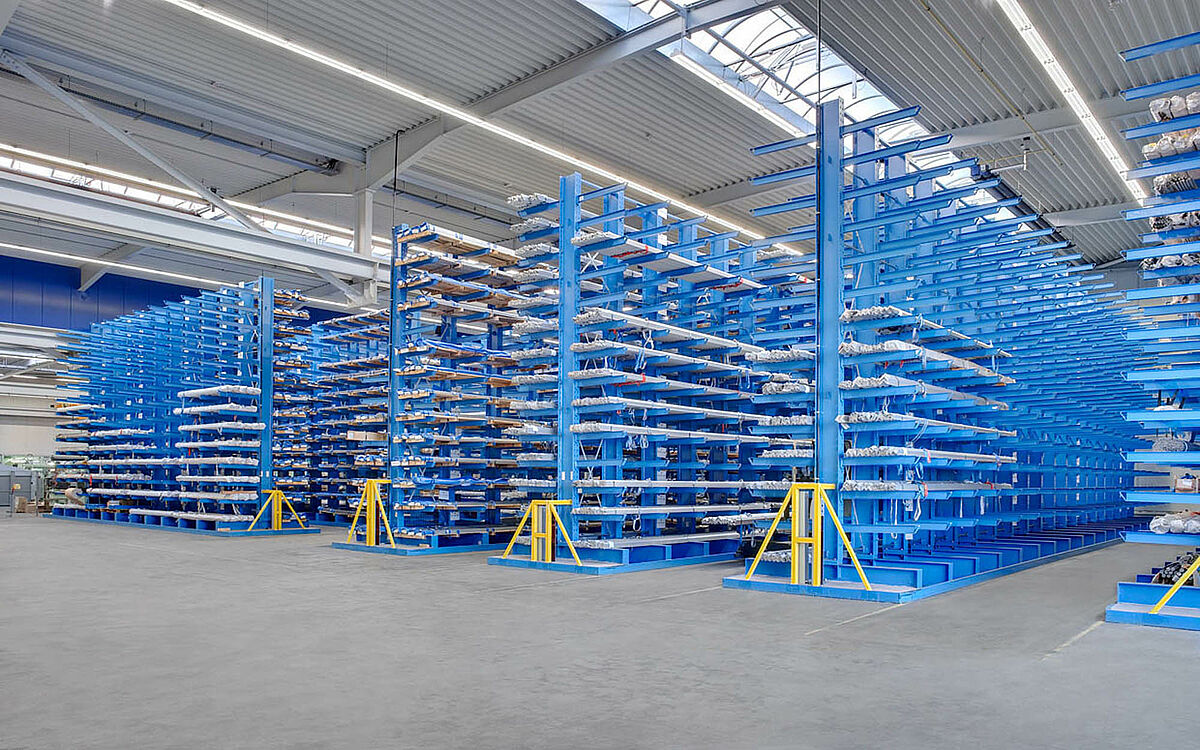
Storage space is one of the biggest cost factors—both in terms of rent or construction costs and energy, maintenance, and internal travel distances. Smart space utilization therefore saves not only room but also real money. A key lever is vertical densification: instead of expanding outward, it often pays to store upward—such as with cantilever racks for long goods or multi-level racking systems that maximize volume on a small footprint.
Modern racking systems that are tailored to product structure, turnover frequency, and picking logic ensure short paths and faster handling. Pallet racks or double-sided cantilever racks from OHRA offer exceptional flexibility, as they can be expanded modularly.
Another optimization potential lies in reducing intermediate storage or buffer zones. These are often set up to prevent bottlenecks but cause unnecessary movements, long search times, and high inventory levels. The goal should always be a continuous material flow—from goods receipt to dispatch, without detours.
Space is used most efficiently when warehouse layout, processes, and systems are coordinated and regularly reviewed to identify dead zones, duplicate storage, or improperly sized areas.
Streamline and automate processes
Complex manual processes are among the invisible cost drivers in warehouses. They increase lead times, raise the risk of errors, and tie up personnel resources that are needed elsewhere.
A central approach to lowering warehouse costs is the automation of repetitive processes. Even simple equipment like roller conveyors or lift tables reduces the time spent on internal transport. While it doesn’t replace an entire team, it eliminates countless manual steps that add up over shifts.
Significant progress can also be made in order picking. Instead of working with static lists or paper slips, digital pick-by solutions enable guided, error-free retrieval. Pick-by-Light, Pick-by-Voice, or Pick-by-Scan systems reduce error rates and make it easier to train new employees. The right method depends on product range, item structure, and turnover frequency. There are no one-size-fits-all solutions—but plenty of proven approaches.
Efficient processes always require a well-thought-out layout: storage locations, routing, and staging areas should align with material flow. The fewer detours, interim storage points, and searches are needed, the more economical the warehouse operates—even without high-end automation.
Digitize warehouse management
Digital warehouse management is now a fundamental requirement for efficient operations. If you’re still recording warehouse data in Excel sheets or on paper, you risk failure through your own processes: duplicate bookings, missing inventory, search times, and costly picking errors are common results.
A professional Warehouse Management System (WMS) provides transparency over inventory and helps control resources precisely. The major advantage: information is available in real time—covering utilization, storage location, relocations, and movements. Decisions are no longer based on gut feeling but on reliable data.
Digital tools also allow processes to be recorded mobile and independent of location. With mobile scanners, tablets, or handhelds, employees maintain an overview—whether at goods receipt, relocation, or picking. This saves time and prevents errors.
Typical functions of modern WMS systems:
- Real-time inventory management
- Random or fixed storage location assignment
- Integrated picking strategies
- Mobile data capture via scanning
- Automated alerts for under- or overstock
- Interfaces to ERP or merchandise management systems
Implementation pays off even in mid-sized warehouses. Once manual processes stop scaling, errors and costs increase.
Training and raising staff awareness
Technology, systems, and strategies are of little use if warehouse staff don’t get on board. When employees understand how workflows function, where risks lie, and how to handle systems properly, they work more efficiently, safely, and accurately.
Targeted training ensures that everyone on the team speaks the same language—whether in picking, goods receipt booking, or when using digital tools. It’s not just about technical instruction but also about understanding business implications: What does a picking error cost? How does an incorrect booking affect stock? Where is time lost every day?
Key topics for staff training:
- Proper use of WMS systems
- Handling mobile scanners and digital checklists
- Occupational safety & warehouse order
- Efficient routing & ergonomic work
- Error reduction in picking and shipping
Make your employees aware that company success is also a personal achievement for every individual.
When savings don’t pay off
Cost reduction is not an end in itself. Poorly targeted measures can cause more harm than good. Too little inventory leads to delivery bottlenecks and dissatisfied customers. Cheap technology often brings high maintenance costs or doesn’t fit the existing system. And without trained personnel, errors creep in that end up costing more than any saving.
A warehouse must operate smoothly. Therefore, it’s worth examining the relationship between cost and risk. Lean processes must not come at the expense of stability.
Future-proof warehousing arises from balanced decisions: save where it makes sense – invest where it’s necessary. Especially when doing so secures quality, efficiency, or delivery reliability.
Sometimes it’s cheaper to spend more—especially when that investment prevents costly mistakes, dissatisfied customers, or constant shortages.
Automated warehouse solutions
Automated storage systems are no longer considered a luxury but a strategic key to increasing efficiency. Companies that automate their warehouse processes benefit not only from lower operating costs but also from greater transparency, availability, and safety.
An automated warehouse minimizes manual intervention. This reduces error rates, speeds up storage and retrieval, and ensures a steady material flow—even with high throughput. At the same time, space is used more efficiently through compact vertical or dynamic racking systems, creating room for growing assortments or new processes.
The investment also pays off economically: less personnel effort with simultaneous employee relief, lower inventory costs due to precise stock management, reduced error costs, and often a faster return on investment than expected.
Typical advantages of automated warehouse solutions at a glance:
- Space savings: optimal space utilization through compact systems
- Time efficiency: shorter access times and automated workflows
- Reliability: fewer errors through system-controlled operations
- Safety: controlled access and clear process management
- Scalability: systems grow with your needs
- Employee relief: staff are freed from routine tasks
As a manufacturer of automated warehouse solutions, OHRA offers modular systems that can be customized to stored goods, industry, and processes. The focus lies on durable technology, high load capacity, and flexible integration into existing operations.
Conclusion
Not every dollar can be saved immediately—but every process can be questioned. A warehouse that runs in a structured, lean, and stable way is a competitive strength.
Even small changes in inventory management, space utilization, or workflows can have a big impact—provided they follow a clear strategy. It’s not about cutting costs at any price but about targeted optimization. About decisions based on reliable data. And about understanding that efficiency always arises where people, technology, and structure work together.
Reducing warehouse costs doesn’t mean starting from scratch. It means taking a closer look—and acting with sound judgment.
